
Written May 12, 2026
Summary:
- How long timber mats last is driven by wood strength, species grade, and defect level — not size or price alone. A mat with higher structural strength has more capacity in reserve, which means it fatigues more slowly under repeated heavy loads.
- Species and grade create real, measurable differences in lifespan. As an example, publicly available data shows Eucalyptus rated at roughly twice the bending strength of mixed hardwood #1 — and that structural gap translates directly into years of additional field life.
- The right question isn’t “how much does a mat cost?” — it’s “what is the cost per month of reliable service?” A mat that lasts three to four times longer at a modest price premium almost always wins on total cost of ownership.
Timber mats can last a season, a year, or the better part of a decade. The better question is this: what is the mat made from, how strong is the fiber, and how hard will the jobsite treat it?
A mat is not a mat. Two mats can share the same dimensions and deliver completely different lifespans. One may be scrap in eighteen to twenty-four months. Another may stay in service for five to seven years or longer.
Longevity Is Proportional to Strength
How long timber mats last is mostly a relationship between load and capacity. If a mat is asked to carry loads near the edge of its structural capacity every day, it fatigues faster. If the mat has more strength in reserve, it has a better chance of surviving the same work.
That is why species and grade matter. For example, publicly available data (see for example Duerr and American Wood Council National Design Standards)shows Eucalyptus at 2,000 psi bending strength, compared with 1,000 psi for mixed hardwood #1 and 550 psi for mixed hardwood #2. That is the difference between buying a product with safety margin and buying a product that may already be working too hard.
Mixed hardwood can include a broad range of species and defects that reduce the actual working section of the timber. When the specification says only “mixed hardwood,” the buyer has described a category, not a structural product.
What Eucalyptus Looks Like in the Field
WFG’s field experience with Eucalyptus mats is useful because it does not come from showroom conditions. A batch of 18′ x 4′ x 8″ Eucalyptus pipeline mats manufactured in May 2016 worked as a temporary road outside WFG’s manufacturing facility until January 2023. They sat in mud, rain, and humidity while carrying 90,000 lb. log trucks and forklifts.
After 6.5 years, the wood was still dense and strong enough to be remanufactured into new ground protection mats. The raw material still had enough integrity to be used again.
Under similar operating, handling, and environmental conditions, an 8″ Eucalyptus mat often belongs in the 5 to seven year range when handled with reasonable care. That is not a promise for every jobsite. Machinery, ground bearing conditions, handling, and basic mat care still matter.
Where Mats Lose Their Life
Rot, defects, and poor end treatment all shorten mat life. Splits, checks, wane, bark, poor geometry, and weak timbers create places where water enters and failure starts.
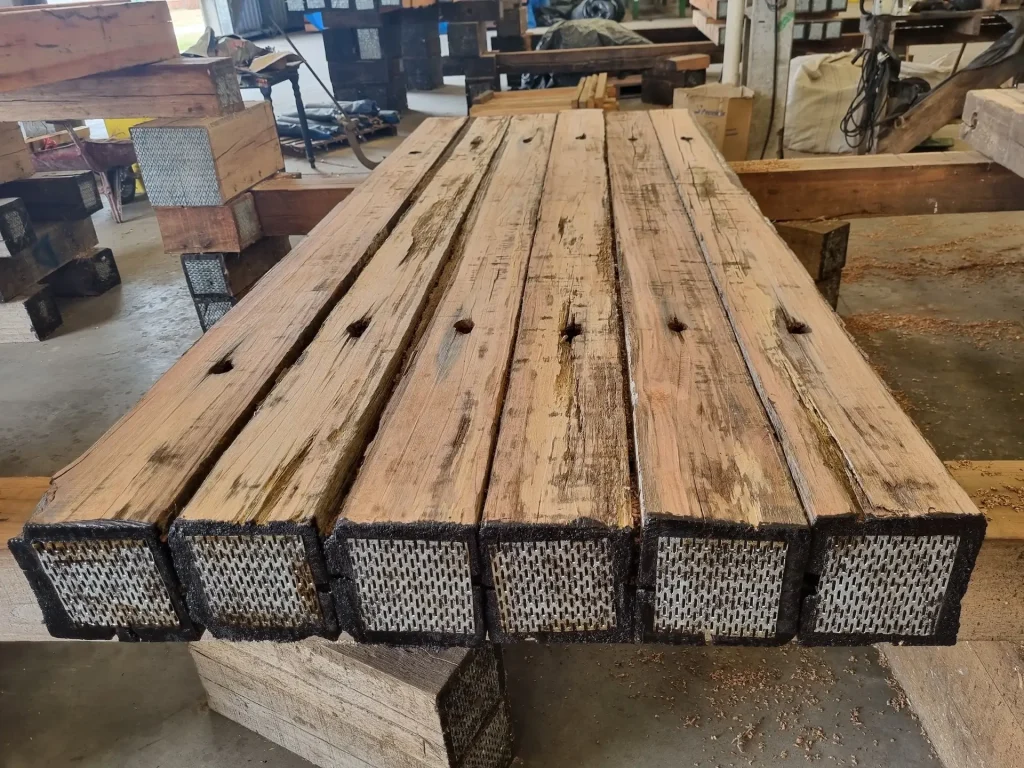
End treatment matters because the ends of the timbers are vulnerable. Every World Forest Group’s mat guide includes metal end plates, phytosanitary treatment, and end sealing as part of its manufacturing guarantee. Metal end plates are industry standard worldwide for timber construction and provide greater strength and timber integrity. In the USA those plates are called “truss plates”. Every home in America built with lumber has building code mandated truss plates in it.
Handling matters too. WFG’s “How to Destroy a Eucalyptus Timber Mat” test punished mats with scrape-and-flip cycles, 15-foot drops, poor soils, and heavy concrete truck traffic. The mats survived more than 8,000 in/out truck cycles trips and roughly 565 million pounds of traffic over about eleven months. The worst visible damage came partly from bucket lifting after the fifth move.
That tracks with the practical truth of mat fleets. Dropping, dragging, gouging, rushed fork handling, and abused edges all steal life from the mat.
Eucalyptus vs. Mixed Hardwood Longevity
Factor | WFG Eucalyptus Mats | Mixed Hardwood Mats |
Raw material | Plantation-grown Eucalyptus, one strong species | Variable species mix |
Bending strength | Listed at 2,000 psi | Listed at 1,000 psi for #1 and 550 psi for #2 |
Expected field life | 5 to 7 years in guide materials, often 7 to 10 years in harsh conditions with reasonable care | 18 to 24 months |
Defect approach | Square timbers, no wane, dimensional accuracy | Quality depends on species, grade, defects, and supplier specification |
End protection | End-sealed and metal end plates | Paint, not end-sealed for most mats |
Economic result | Higher strength reserve and longer service life reduce monthly depreciation | Lower initial price outweighed by replacement and freight |
The TCO Answer
If a mat costs a little more but lasts twice as long, it is cheaper per month of service.
That is the point buyers often miss when they compare bids instead of ownership cost. WFG’s crane mat guide shows an 18′ x 4′ x 12″ Eucalyptus mat at $1,200 with a 60-month lifespan, or $20.00 per month. A mixed hardwood #2 mat costs ~$975 with a 21-month lifespan, or $46.43 per month.
Similar ratios exist for 18’ pipeline mats and 16’ powerline mats.
Higher purchase price is not the same as higher cost. A stronger mat that avoids premature replacement is the better economic product.
Depreciation Isn’t the Only Driver
Mats are heavy and relatively inexpensive. So freight is a big deal. If your mat is lighter it costs you less to deliver. If it’s true-to-size you need to deliver and ship less mats. For example, World Forest Group’s mats are true to size at a full 48″ wide vs. 42″-45″ for typical mats. That means for every 10 typical mat, you can use 9 Eucalyptus mats.
Ask a Better Question
So, how long do timber mats last? Weak mixed hardwood mats may be done in eighteen to twenty-four months. Properly manufactured Eucalyptus mats can reasonably target five to seven years, with longer life with reasonable care.
The right question is not “What is the cheapest mat?” It is “What mat gives me the lowest cost per month of reliable service?”
If you are buying for pipeline, transmission, renewable energy, heavy lift, or utility work, contact World Forest Group. WFG can help you compare the real cost before the jobsite teaches the lesson the expensive way.
Pro Tip
If you want a Eucalyptus alternative but don’t want to buy right now, you can consider leasing or a lease to buy option.
Questions? Contact us!

